ORGANS OF PARIS © 2026 Vincent Hildebrandt HOME ALL ORGANS
Organs in concert halls
Non-exhaustive list
•
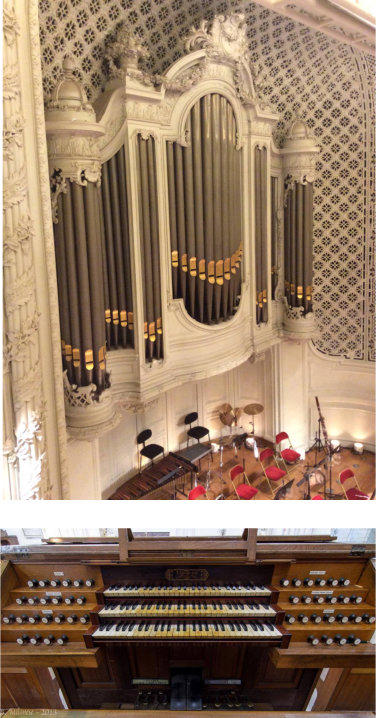
George Blumenthal residence
In 1921, Florence Meyer Blumenthal (1875–1930), the
wife of New York banker George Blumenthal
(1858–1941), decided to install an organ in a large hall
adjoining her Paris residence. A great patron of
French art, she did not hesitate to devote a
substantial part of her fortune to promoting its
development. She dreamed of a music room where
organists could give recitals and hold organ
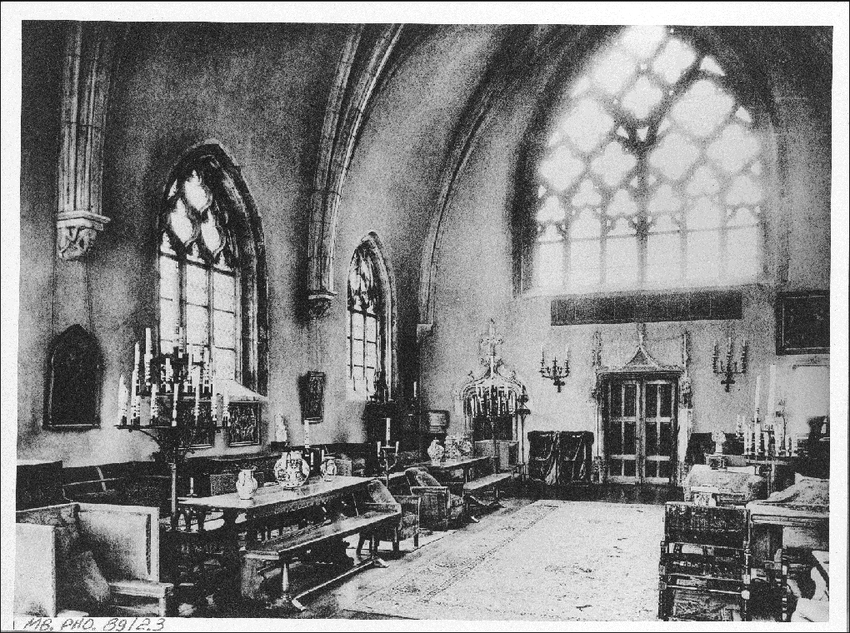
competitions. To bring this project to life, she had a
“Gothic hall” added to her home between 1920 and
1922, built using elements taken from churches
destroyed during the First World War. The organ had
to be as advanced as possible, and the layout of the
hall required the use of electric action. Joseph Bonnet
was entrusted with drawing up the specifications and
the stoplist, as well as overseeing the construction of
the instrument. The work was completed in August
1923. The hall then became a favourite meeting place
for the foremost Parisian organists of the time,
among them Charles-Marie Widor, Alexandre
Guilmant, Marcel Dupré, Louis Vierne, and Joseph
Bonnet himself. Upon Madame Blumenthal’s death in
1930, Joseph Bonnet inherited the organ. In 1934, the
abbey purchased the instrument, which was then
reinstalled on the gallery of the newly completed
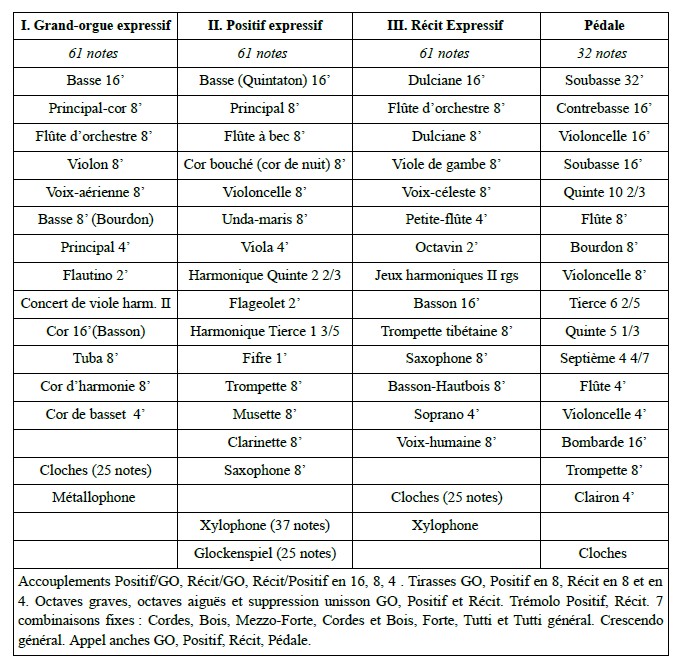
abbey church. Source
A special thanks to James Lewis for this information.
•
Salle d’orgue de Marthe Bracquemond (rue Louis-
David)
The composer and organist Marthe Bracquemond
(1898–1973) rented a hall during and after the second
world war, containing an organ, where she gave
concerts. A newspaper announcement mentions
concerts at the “salle d’orgue de Marthe
Bracquemond.” She may have used this space for
recitals, teaching, and/or practicing. Source
•
Cité de la musique
•
Concert Hall of Marcel Dupré (Meudon)
•
Concert Hall of Guilmant (Meudon)
In 1898, Félix-Alexandre Guilmant had a concert hall
built next to his house, Villa Guilmant in Meudon,
where Aristide Cavaillé-Coll built an organ in 1899,
completed by Charles Mutin. After Guilmants death in
1911 the house containing the organ was sold, and
the organ stayed there until 1926. Then the new
owners moved to another place, and the organ had
to be removed. Marcel Dupré bought the organ. He
gave a last concert in the house of Guilmant in
February 1926.
•
Hôtel Majestic (avenue Kléber)
Inaugurated on 23 December 1926 by Marcel Dupré,
this Czechoslovakian-built Rieger organ was donated
by Mr. L. Tauber to the Salle Majestic as part of a
project by Jean Huré. In 1937, the organ was
transferred to Saint-Michel-des-Batignolles, by
Gonzalez.
•
Institut de France, Pavillon de Caen
Organ of Widor.
•
Maison de Radio France
•
Opéra comique
•
Palais du Trocadéro/Palais de Chaillot
•
Philharmonie de Paris
•
Les Portiques des Champs-Élysées
Organ of Convers, 1928, now at the au Temple
Protestant in Amiens. Composition
•
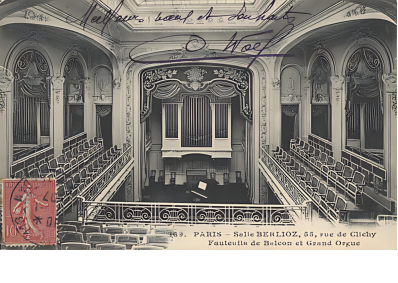
Salle Berlioz (now: Théâtre de l’œuvre)
This organ was built by Aristide Cavaillé-Coll in 1890.
In 1909, it was transfered to the church Sainte
Geneviève des grandes carrières.
Original composition
•
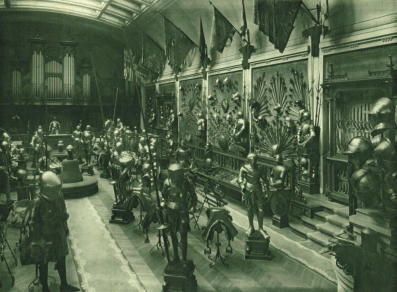
Salle d’armes de M. Pauilhac
An organ of , 1912, constructed with the tubular
system on indications of Docteur Bédart. 48 stops
and three expressive keyboards. This instrument
disappeared.
•
Salle de concert de l'ancien Conservatoire (rue du
Conservatoire)
Convers organ, 1925. Inaugurated on 12 March 1928
by Marcel Dupré. A gift from Mrs. Braunstein. Three-
manual electro-pneumatic organ with 61-note
manuals and 39 stops, installed in a 300-seat hall.
This organ was used for Radio Paris broadcasts.
•
Salle de concert de l’Association Valentin Haüy
serving the blind and visually impaired.
In May 1929, an organ was inaugurated by Marcel
Dupré for the benefit of the “Radio for the Blind.” In
1967, a new instrument was inaugurated. Designed
according to plans drawn up by Jean Langlais and
Gaston Litaize, two renowned blind organists, its
construction was entrusted to the Alsatian organ
builder Curt Schwenkedel. In 2010, as the Valentin
Haüy Association no longer had use for the
instrument, it offered to donate it to a place fitting its
history and quality. The Commission for Sacred Art of
the Diocese of Créteil, which was seeking an organ for
the newly planned cathedral, submitted its proposal,
and the Valentin Haüy Association agreed to the
organ’s transfer to the new cathédrale de Créteil.
•
Salle de Musique of Henry Goüin
Henry Goüin (Henry Jules Goüin, 1900–1977), a
passionate music lover, had his townhouse on
Avenue Milleret-de-Brou enlarged in 1932 to include
a music salon. He had a Gonzalez organ installed
there, which was inaugurated by the organist André
Marchal. The music salon soon became one of the
most sought-after in Paris, and the organ was also
used for recordings. Two years before his death, the
instrument was moved to the Church of Sainte-
Marguerite in Vésinet. In 2002, it was restored by
Marc Hédelin. On that occasion, the console was
replaced, an electronic combination system was
added, and six new stops were installed.
•
Salle des fêtes du pensionnat de Passy
•
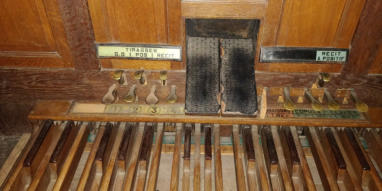
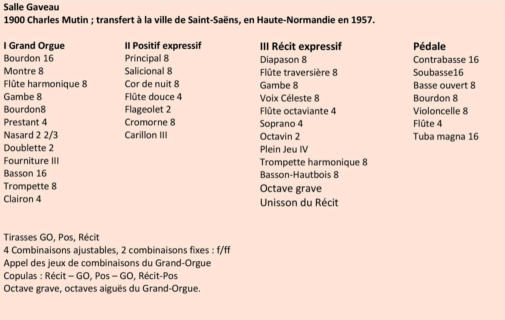
Salle Gaveau
•
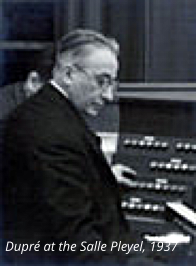
Salle Pleyel
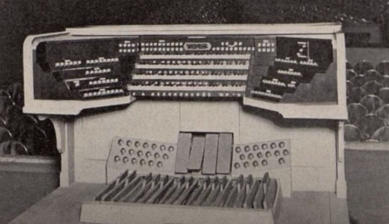
This hall housed a big organ, built by the Société
anonyme française de facture d’orgues Cavaillé-Coll in
1929 (IV/70) and inaugurated by Marcel Dupré in
1930. It was removed in the fifties and seems to have
been moved several times during the follwing years.
It was bought by the Italian organ builder Formentelli
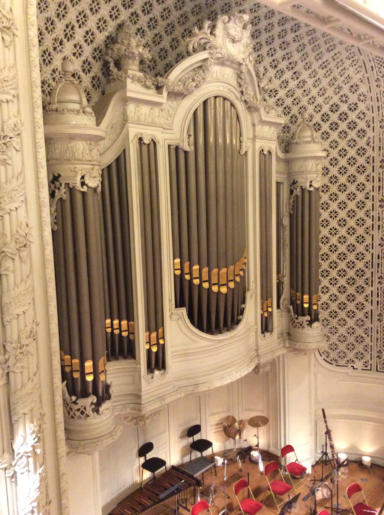
and stored in a warehouse. There is only a photo of
the console, the organ had no case. Photos of the
pipework (thanks to Christian Tedesco).
Dupré's description of the Salle Pleyel organ.
Original composition
•
Salle de concerts Touche
Organ of Mutin (1906). Vierne gave often lessons in
this hall.
Moved to l'église Saint-Dominique de Paris in 1926
and later to Saint-Antoine-de-Padoue after the
second world war.
•
Salle de l'Union (rue Trévise)
Organ disappeared
•
Studio 103 et 104 de la Maison de Radio-France
The organ of Müller of Studio 103 was transferred in
2008 to l'église Sainte Jeanne-d'Arc de Versailles.
The Gonzalez organ of Studio 104 was transferredto
Notre-Dame-de-la-Treille, the cathedral of Lille.
•
Théâtre des Champs Élysée
•
Théâtre de l'Empire (avenue de Wagram)
1886 - 2005
Organ of an unknown builder
•
Théâtre de l’œuvre (see: Salle Berlioz)
•
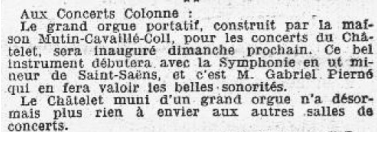
Théâtre du Châtelet/Concerts Colonne
Organ of Mutin, built at the beginning of the XXth
century and sold in 1927 to the parish of Saint-
Nicolas, Meursault (Côte-d'Or). It’s stoplist is identical
to that of the choir organ of Notre-Dame-de-la-Croix.
Source et composition
•
Théâtre Lyrique
The organ of the Hall at the Boulevard du Temple
(Cavaillé-Coll, 1859, II/8): moved as choir organ to the
Cathédrale de Grenoble in 1869, after that to the Petit
Séminaire de Saint-Antoine-L'Abbaye (1928) and
finally to the Church of St. Didier of Voreppe.
Current composition
The organ of the Hall at the Place du Châtelet (Cavaillé-
Coll, 1864, II/8): Transferred to Belle-Ile-en-Mer in
1875 by Cavaillé who added the buffet and the pipes
in front. Restored by Bernard Hurvy, 1992.
Composition
•
Théâtre Pigalle
Convers organ, 1932. Inaugurated by Marcel Dupré.
The organ had been acquired on the advice of Dupré,
Huré, Whip, and Montillet. In 1958, after the theatre
was demolished, it was purchased by the Paris
Conservatoire, which never made use of it. It is said
to have later gone to Saint Petersburg.
Cinema organs…
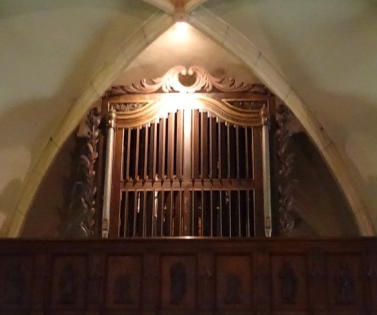
Saint-Nicolas, Meursault




Guilmant at the organ in his concert hall







Organs of Paris

Organs in concert
halls
Non-exhaustive list

ORGANS OF PARIS © 2026 Vincent Hildebrandt

•
George Blumenthal residence
In 1921, Florence Meyer Blumenthal (1875–1930),
the wife of New York banker George Blumenthal
(1858–1941), decided to install an organ in a large
hall adjoining her Paris residence. A great patron of
French art, she did not hesitate to devote a
substantial part of her fortune to promoting its
development. She dreamed of a music room where
organists could give recitals and hold organ
competitions. To bring this project to life, she had a
“Gothic hall” added to her home between 1920 and
1922, built using elements taken from churches
destroyed during the First World War. The organ
had to be as advanced as possible, and the layout of
the hall required the use of electric action. Joseph
Bonnet was entrusted with drawing up the
specifications and the stoplist, as well as overseeing
the construction of the instrument. The work was
completed in August 1923. The hall then became a
favourite meeting place for the foremost Parisian
organists of the time, among them Charles-Marie
Widor, Alexandre Guilmant, Marcel Dupré, Louis
Vierne, and Joseph Bonnet himself. Upon Madame
Blumenthal’s death in 1930, Joseph Bonnet inherited
the organ. In 1934, the abbey purchased the
instrument, which was then reinstalled on the
gallery of the newly completed abbey church.
Source
A special thanks to James Lewis for this information.
•
Salle d’orgue de Marthe Bracquemond (rue Louis-
David)
The composer and organist Marthe Bracquemond
(1898–1973) rented a hall during and after the
second world war, containing an organ, where she
gave concerts. A newspaper announcement
mentions concerts at the “salle d’orgue de Marthe
Bracquemond.” She may have used this space for
recitals, teaching, and/or practicing. Source
•
Cité de la musique
•
Concert Hall of Marcel Dupré (Meudon)
•
Concert Hall of Guilmant (Meudon)
In 1898, Félix-Alexandre Guilmant had a concert hall
built next to his house, Villa Guilmant in Meudon,
where Aristide Cavaillé-Coll built an organ in 1899,
completed by Charles Mutin. After Guilmants death
in 1911 the house containing the organ was sold,
and the organ stayed there until 1926. Then the new
owners moved to another place, and the organ had
to be removed. Marcel Dupré bought the organ. He
gave a last concert in the house of Guilmant in
February 1926.
•
Hôtel Majestic (avenue Kléber)
Inaugurated on 23 December 1926 by Marcel Dupré,
this Czechoslovakian-built Rieger organ was
donated by Mr. L. Tauber to the Salle Majestic as
part of a project by Jean Huré. In 1937, the organ
was transferred to Saint-Michel-des-Batignolles, by
Gonzalez.
•
Institut de France, Pavillon de Caen
Organ of Widor.
•
Maison de Radio France
•
Opéra comique
•
Palais du Trocadéro/Palais de Chaillot
•
Philharmonie de Paris
•
Les Portiques des Champs-Élysées
This organ was built in 1928 by Convers for a
shopping arcade, the Portiques des Champs-Élysées
in Paris. Just ten years later, the instrument was
dismantled. It then remained in storage for more
than sixty years, before being reassembled between
1989 and 2000 in the Protestant Church of Amiens.
Composition
•
Salle Berlioz (now: Théâtre de l’œuvre)
This organ was built by Aristide Cavaillé-Coll in 1890.
In 1909, it was transfered to the church Sainte
Geneviève des grandes carrières.
Original composition
•
Salle d’armes de M. Pauilhac
An organ of , 1912, constructed with the tubular
system on indications of Docteur Bédart. 48 stops
and three expressive keyboards. This instrument
disappeared.
•
Salle de concert de l'ancien Conservatoire (rue
du Conservatoire)
Convers organ, 1925. Inaugurated on 12 March 1928
by Marcel Dupré. A gift from Mrs. Braunstein. Three-
manual electro-pneumatic organ with 61-note
manuals and 39 stops, installed in a 300-seat hall.
This organ was used for Radio Paris broadcasts.
•
Salle de concert de l’Association Valentin Haüy
serving the blind and visually impaired.
In May 1929, an organ was inaugurated by Marcel
Dupré for the benefit of the “Radio for the Blind.” In
1967, a new instrument was inaugurated. Designed
according to plans drawn up by Jean Langlais and
Gaston Litaize, two renowned blind organists, its
construction was entrusted to the Alsatian organ
builder Curt Schwenkedel. In 2010, as the Valentin
Haüy Association no longer had use for the
instrument, it offered to donate it to a place fitting
its history and quality. The Commission for Sacred
Art of the Diocese of Créteil, which was seeking an
organ for the newly planned cathedral, submitted its
proposal, and the Valentin Haüy Association agreed
to the organ’s transfer to the new cathédrale de
Créteil.
•
Salle de Musique of Henry Goüin
Henry Goüin (Henry Jules Goüin, 1900–1977), a
passionate music lover, had his townhouse on
Avenue Milleret-de-Brou enlarged in 1932 to include
a music salon. He had a Gonzalez organ installed
there, which was inaugurated by the organist André
Marchal. The music salon soon became one of the
most sought-after in Paris, and the organ was also
used for recordings. Two years before his death, the
instrument was moved to the Church of Sainte-
Marguerite in Vésinet. In 2002, it was restored by
Marc Hédelin. On that occasion, the console was
replaced, an electronic combination system was
added, and six new stops were installed.
•
Salle des fêtes du pensionnat de Passy
•
Salle Gaveau
•
Salle Pleyel
This hall housed a big organ, built by the Société
anonyme française de facture d’orgues Cavaillé-Coll in
1929 (IV/70) and inaugurated by Marcel Dupré in
1930. It was removed in the fifties and seems to
have been moved several times during the follwing
years. It was bought by the Italian organ builder
Formentelli and stored in a warehouse. There is only
a photo of the console, the organ had no case.
Photos of the pipework (thanks to Christian
Tedesco).
Original composition
•
Salle de concerts Touche
Organ of Mutin (1906). Vierne gave often lessons in
this hall.
Moved to l'église Saint-Dominique de Paris in 1926
and later to Saint-Antoine-de-Padoue after the
second world war.
•
Salle de l'Union (rue Trévise)
Organ disappeared
•
Studio 103 et 104 de la Maison de Radio-France
The organ of Müller of Studio 103 was transferred in
2008 to l'église Sainte Jeanne-d'Arc de Versailles.
The Gonzalez organ of Studio 104 was transferredto
Notre-Dame-de-la-Treille, the cathedral of Lille.
•
Théâtre des Champs Élysée
•
Théâtre de l'Empire (avenue de Wagram)
1886 - 2005
Organ of an unknown builder
•
Théâtre de l’œuvre (see: Salle Berlioz)
•
Théâtre du Châtelet/Concerts Colonne
Organ of Mutin, built at the beginning of the XXth
century and sold in 1927 to the parish of Saint-
Nicolas, Meursault (Côte-d'Or). It’s stoplist is
identical to that of the choir organ of Notre-Dame-
de-la-Croix. Source et composition
•
Théâtre Lyrique
The organ of the Hall at the Boulevard du Temple
(Cavaillé-Coll, 1859, II/8): moved as choir organ to
the Cathédrale de Grenoble in 1869, after that to the
Petit Séminaire de Saint-Antoine-L'Abbaye (1928)
and finally to the Church of St. Didier of Voreppe.
Current composition
The organ of the Hall at the Place du Châtelet
(Cavaillé-Coll, 1864, II/8): Transferred to Belle-Ile-en-
Mer in 1875 by Cavaillé who added the buffet and
the pipes in front. Restored by Bernard Hurvy, 1992.
Composition
•
Théâtre Pigalle
Convers organ, 1932. Inaugurated by Marcel Dupré.
The organ had been acquired on the advice of
Dupré, Huré, Whip, and Montillet. In 1958, after the
theatre was demolished, it was purchased by the
Paris Conservatoire, which never made use of it. It is
said to have later gone to Saint Petersburg.
Cinema organs…