



ORGANS OF PARIS © 2026 Vincent Hildebrandt HOME ALL ORGANS
Chamber organs
(Residence organs/Home organs/House organs -
Orgues de salon)
Non-exhaustive list
•
Comtesse de Béhague
Organ Charles Mutin (1906), moved to the Palais de
Béhague in the big concert hall (Salle Byzantin).
•
Comte Béranger de Miramon Fitz-James
Co-founder of Les Amis de l’Orgue together with Norbert
Dufourcq. In 1926, he had a salon organ built by organ
builder Victor Gonzalez. It was inaugurated on June 27,
1926, by André Marchal.
•
Philippe Bellenot (1860-1928)
Organ of Mutin (1914). Composition.
•
Olivier Bernard (rue Prony)
Organ built by P. Hartmann
•
Mme Roux de Bezieux (avenue du Président Wilson)
Organ of Schwenkedel, 1965.
•
Comte Christian de Bertier de Sauvigny
Organ Merklin (1904). It’s a chamber organ (III/30) of the
landgrave Christian Bertier de Sauvigny (1864-1939). It was
moved to Saint-Dominique in 1944-45. Plus d’info…
•
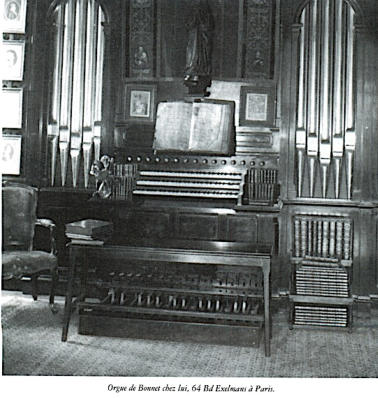
Joseph Bonnet
Organ Mutin (1912, transformed by Convers in 1924). Now
in the chapelle Sainte-Jeanne-d'Arc de Coetquidan
(Morbihan). Thanks to Olivier Geoffroy for this information.
Composition.
•
Nadia Boulanger (1887-1979)
Organ Mutin inaugurated on February 4, 1905. After her
death, the organ is given to the musée de la Cité de la
musique in Paris. Composition.
Another house organ of her is now at the Saint-Jacques
Convent.
•
André Chauvin
Organ Benoit et Sarelot (1986), designed by André Isoir.
Originally, it was the personal organ of André Chauvin,
organist of the Prytanée militaire de La Flèche. The organ
was sold in 2014 to the Centre Hospitalier National
d’Ophtalmologie des Quinze-Vingts and installed in the
Chapelle Saint-Remi.
•
Pierre Cochereau ( bd Berthier)
•
Comtesse de Cossé-Brissac
Organ Mutin (1905). Now in Notre-Dame de Sancerre
(Cher). Composition.
•
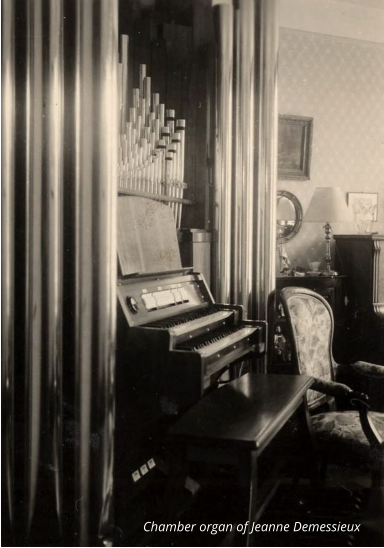
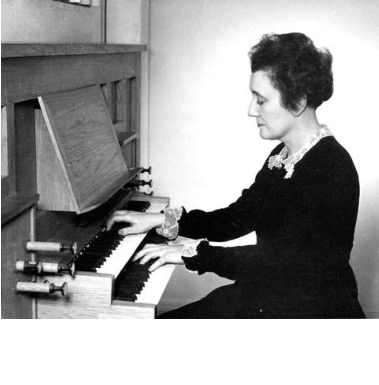
Jeanne Demessieux
Organ of Roethinger. This instrument was installed at the
house of Michel Faverais à la Ferté-sous-Jouarre.
•
Pierre Denis (rue Boileau)
Organ of Gonzalez.
•
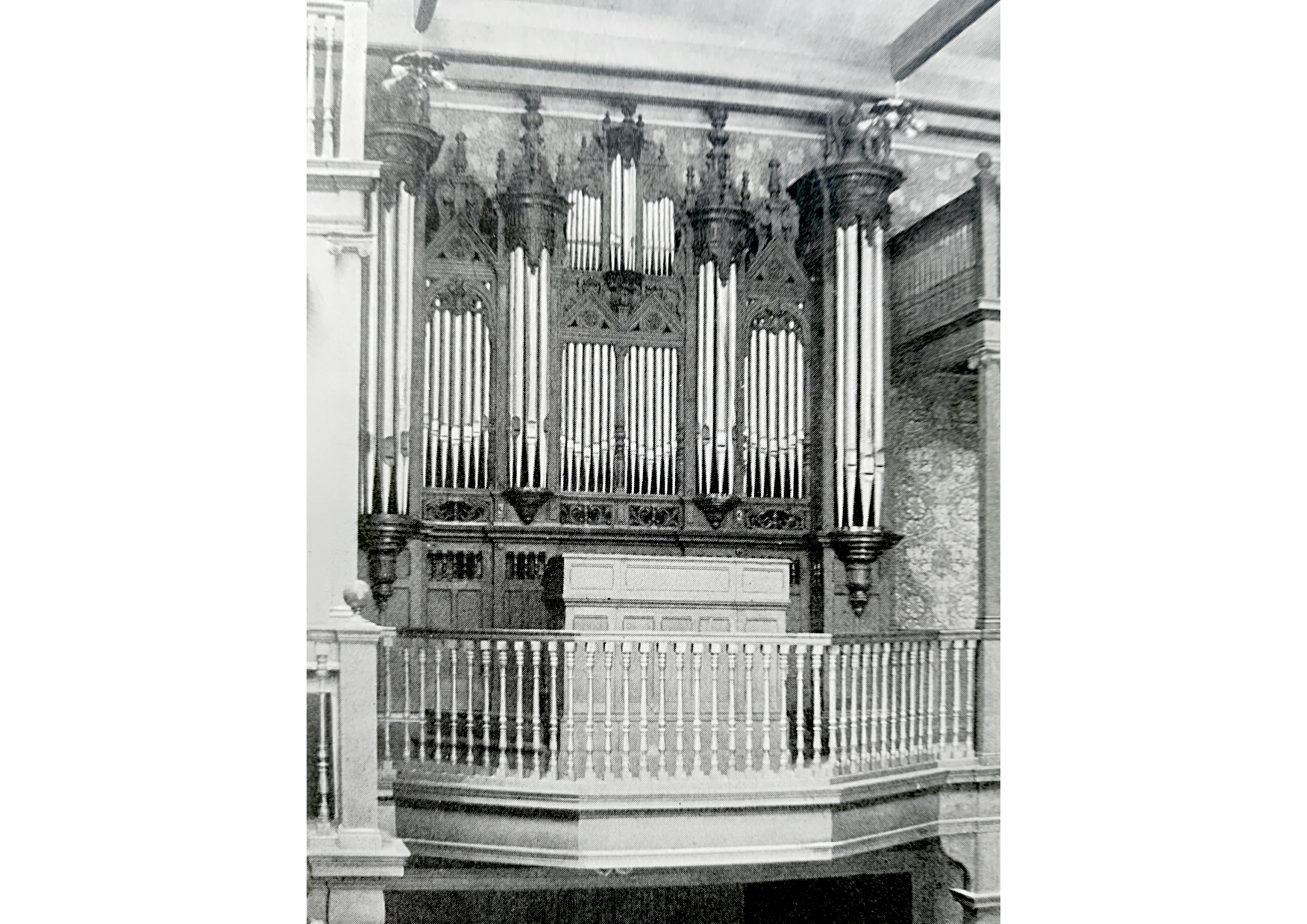
Sarah Louis-Dreyfus
Orgue Charles Mutin (124, III/29)
Thanks to Jim Lewis for the photo of the organ.
This organ was transfered in 1953 to the Chapelle de l’école
Saint-Charles d’Athis-Mons. Source
•
Mme Dujarric
In 1988, this organ of the mansion of Ms Dujarric in
Boulogne-Billancourt, was given to the parish of Sainte-
Odile: due to financial restrictions, the pipework is not yet
installed.
•
Norbert Dufourcq
•
Marcel Dupré
An important part of the organ of Saint-Gabriel (built by
Chrétien et Laurent Steinmetz in 1982) comes from a
Cavaillé-Coll chamber organ which is said to belonged to
Marcel Dupré.
•
Maurice and Marie-Madeleine Duruflé
Organ Gonzalez, 1967 (III/30)
•
Baron d'Erlanger
Organ Cavaillé-Coll, 1865 (opus 250-229). It was given to
the city oif Paris in 1927 by the son of the baron, and then
installed in the chapel of the Sorbonne by Convers-
Cavaillé-Coll and then installed at Saint-Jacques-du-Haut-
Pas.
•
Salon de Mme Flersheim (Rue du Ranelagh)
Inauguration of an organ Cavaillé-Coll-Victor Gonzalez by
André Marchal, June 27, 1931.
•
Jean Galard
Organ (Baby-)Gonzalez, 196x (II/2)
•
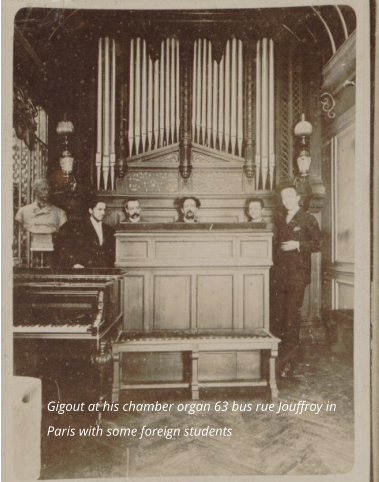
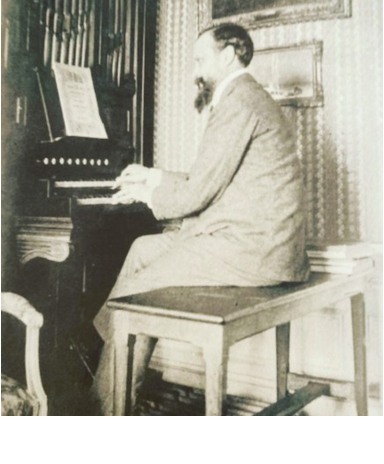
Eugène Gigout
A small organ Cavaillé-Coll (1987) in the mansion of Gigout
at 63 bis rue Jouffroy (XVIIe Arr ). The organ was equipped
with a manual blower that his students operated
themselves during lessons. Gigout sold his organ in 1900
to the Ecole des Francs-Bourgeois.
•
Salle de Musique of the Henry Goüin
Henry Goüin (Henry Jules Goüin, 1900–1977), a passionate
music lover, had his townhouse on Avenue Milleret-de-
Brou enlarged in 1932 to include a music room. He had a
Gonzalez organ installed there, which was inaugurated by
organist André Marchal. The music room soon became one
of the most sought-after in Paris, and the organ was also
used for recordings. Two years before his death, the organ
was moved to Sainte-Marguerite Church in Le Vésinet. In
2002, it was restored by Marc Hédelin: the console was
replaced, an electronic combination system was added,
and six new stops were introduced.
•
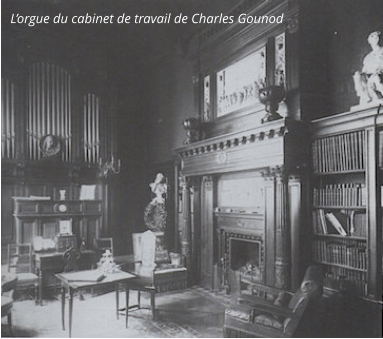
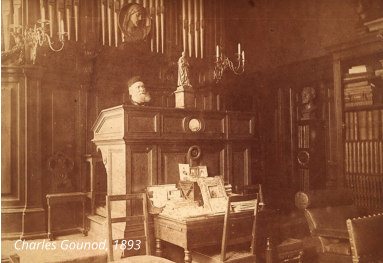
Charles Gounod
Organ Cavaillé-Coll, 1879, II/16 (12). This organ remained
until 1937 in the master's salon (located at 20 Place
Malesherbes in Paris) until his daughter, the Baroness de
Lassus, gave it to the Institut des Jeunes Aveugles in
Bordeaux at the instigation of André Marchal. It was
transferred from Bordeaux to Ambarès-la-Grave (Gironde)
to the Institute for the Deaf and Blind (IRSA) in his original
state. It has been classified as a historical monument since
2009. It is now installed and restored in the church of La
Sauve Majeure (Gironde).
•
Jean Huré
Organ Cavaillé-Mutin (1915-1920). Now in Saint Christophe
de Javel. In 1970, it was reconstructed by Schwenkedel.
•
Georges Jacob (1877-1950)
Organ Mutin (1900-1905). Now in Sainte-Marie-Madeleine
de Domont. Composition.
•
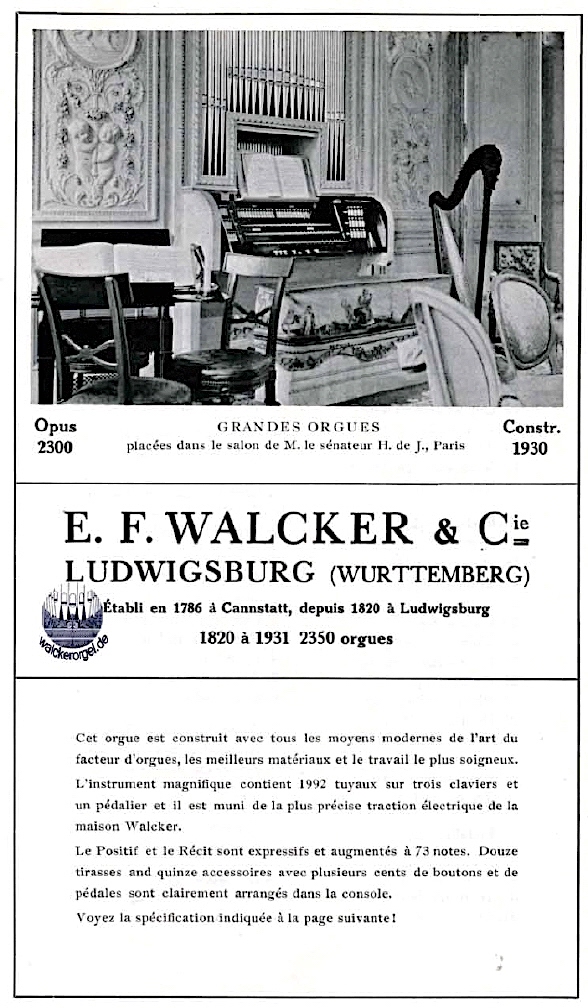
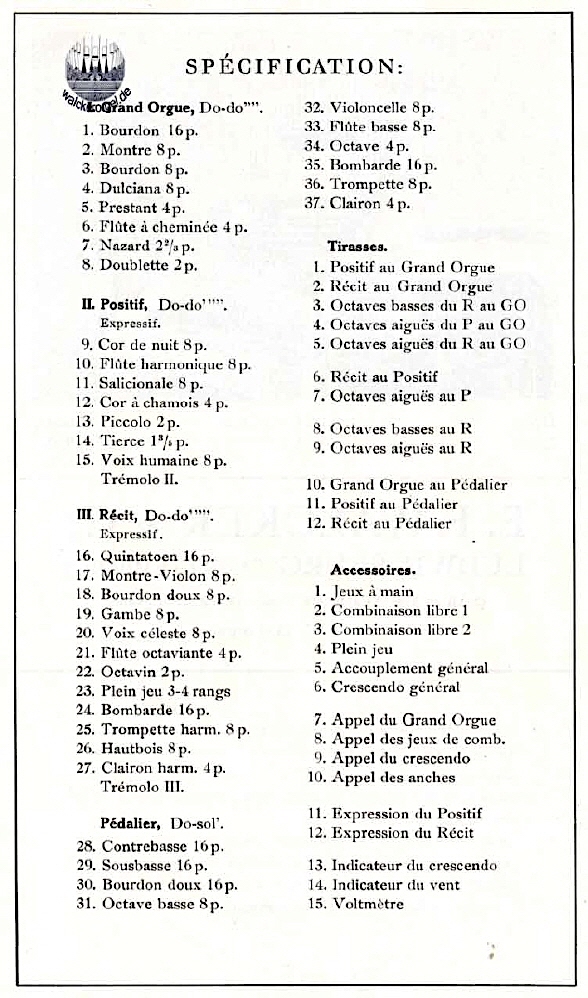
Henri de Jouvenel (1876-1935).
His Parisian salon organ was installed by E. F. Walcker in
1930. Composition. Many thanks to James Lewis for this
information.
•
Jean Langlais
Organ of 2 manuals.
•
André Marchal
Rue Duroc
•
Léonce de St Martin
Organ Gaston Gutschenritter (1922), moved to Notre Dame
de l’Assomption de Passy in 1959.
Composition
•
Baron Albert de l'Espée
See: Sacré-Coeur and Saint-Antoine-de-quinze-vingts
•
André Marchal
The organ at rue Duroc had originally two manuals and pedal,
built by Gütschenritter. It was gradually enlarged. After the end of
World War II, Victor Gonzalez took over and a third manual, an
unenclosed Positif, was added. More information…
•
Baron Albert de l'Espée
See: Sacre-Coeur et Saint-Antoine-de-quinze-vingts
•
Comtesse Anna de Noailles
Organ Cavaillé-Coll (1898).
The Countess sold it in 1905 to the Aviné family of Dreux
(Eure-et-Loir) to reward the grandson of the family: Émile
(pupil of Alexandre Guilmant and Louis Vierne) with his
first organ prize (1904). He ceded the instrument to the
parish of Saint-Joseph des Épinettes at the end of 1910.
According to the national inventory of organs, this organ is
an old salon organ built by Cavaillé-Coll in 1880 for Samuel
Rousseau, as a gift following the obtaining of his Organ
Prize at the Paris Conservatory in the class of Alexandre
Guilmant.
•
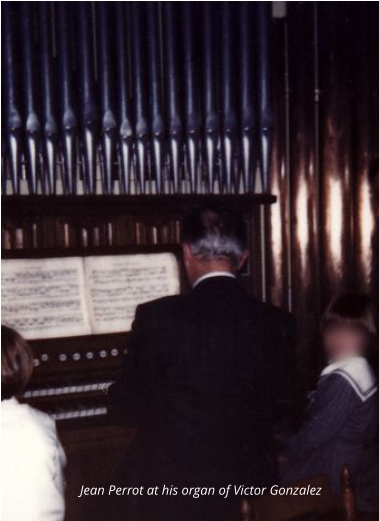
Dr. Jean Perrot
Dr. Jean Perrot (1915-2009), a medical doctor in Paris,
devoted most of his free time to the organ. In 1948, he had
a salon organ built by Victor Gonzalez, following the expert
advice of André Marchal. Many private concerts were held
around his instrument, bringing together some of the
greatest organists of the time, including Gaston Litaize —
who dedicated one of his preludes to him — Norbert
Dufourcq, Marie-Claire Alain, Georges Robert, Claude
Dessenne, Jean Galard, and above all, André Marchal.
•
Noëlie Pierront (19 rue Mazarine)
She was professor and organist at Saint Pierre du Gros
Caillou.
•
Léonce de Saint-Martin (Place des Vosges)
Organ of Gaston Gutschenritter (1922), transferred to
Notre Dame de l’Assomption de Passy in 1959.
Composition
•
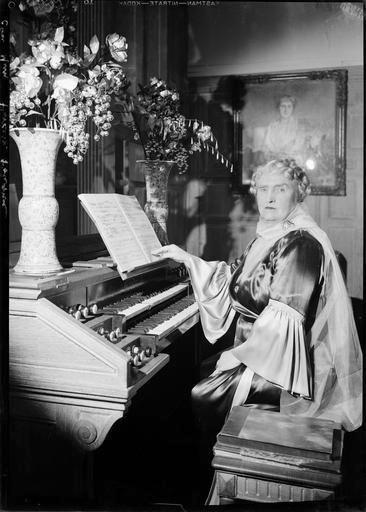
Winnaretta Singer, princesse Edmond de Polignac
Organ of Mutin-Cavaillé-Coll (1902, III/28, transfered in
1935 to the Grand Séminaire of Lille.
Winnaretta Singer (1865-1943) was the daughter of Isaac
Merritt Singer, the American industrialist who perfected the
sewing machine and left his children a great fortune. She
became one of the most important women in the history of
modern music. A skilled pianist and organist, she devoted her
wealth to the arts, especially to music.
The Polignac salon at 43 Avenue Henri-Martin welcomed many
of the major artists of the time—from Proust to Le
Corbusier—but above all musicians such as Clara Haskil,
Nadia Boulanger, Reynaldo Hahn, and Alfred Cortot. The large
salon could seat around 200 guests. In a second music room,
known as the “atelier,” there were two pianos and a Mutin-
Cavaillé-Coll organ. Thanks to Jim Lewis for the photos.
•
Madame Sulzbach
Organ Mutin (1910). Now installed as choir organ in Heilig
Hartkerk Hilversum (Pays-Bas).
•
Charles Tournemire
Adrien/Pierre Maciet owns the personal organ of the
composer Charles Tournemire that his grandfather had
bought in La Roche sur Yon upon the composer's death.
•
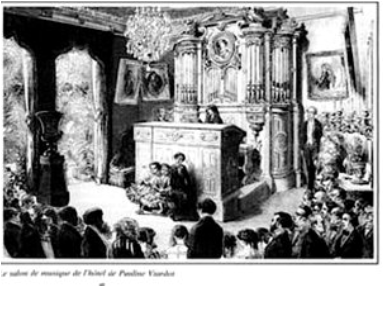
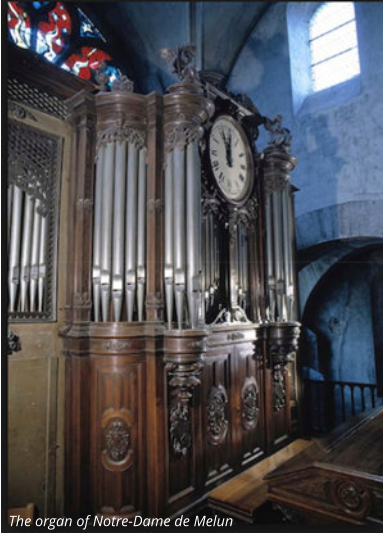
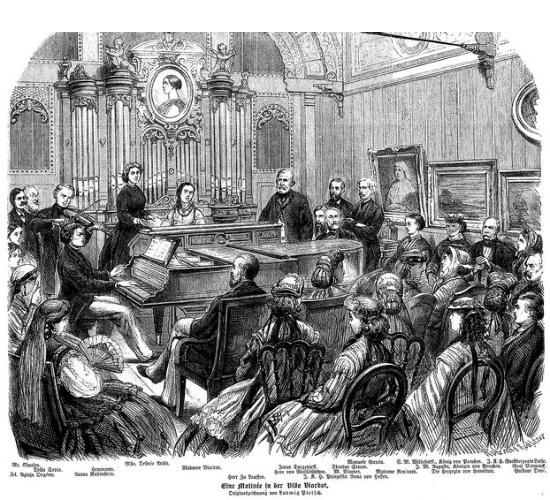
Pauline Viardot
In 1851, Cavaillé-Coll built for the music salon of the singer
Pauline Viardot an organ of 14 stops spread over 2
keyboards and a pedal.
Stoplist (at the origin): 1st keyboard: Flûte harmonique 8,
Flûte octaviante 4, Octavin 2, Dessus Bourdon 16, Basse
Trompette 8, Dessus Trompette 8, Basse Basson 8, Dessus
Hautbois 2nd Keyboard: Principal 8, Bourdon 8, Viole de
gambe 8, Voix céleste 8, Gambe 4, Doublette 2. Pedal :
Bourdon 16, Flûte 8.
It is the instrument around which the cultural elite gathers,
Thursday evenings, at the show of Viardot: Flaubert, Victor
Hugo, George Sand, Delacroix, Doré, Berlioz, Liszt and Saint-
Saëns are there. The console, richly decorated, is separated
from the case and is arranged so that the performer is facing
his audience. The stops of the orchestral color Récit
accompany the solo stops keyboard of the great organ. This is
the first Cavaillé-Coll equipped with a German pedalboard of
30 keys with two pedal games independent Bourdon 16 and
Flute 8. Pauline Viardot accompanies when she sings a
repertoire borrowed from the opera and she plays them She
invites famous organists such as Alexandre Guilmant and
those of the rising generation, like Eugène Gigout introduced
by Camille Saint-Saëns. (from the Bulletin of the Friends of
the Quebec Organ No. 18).
This organ was presented by Cavaillé-Coll at the Universal
Exhibition of 1855, it followed the Viardot couple to
Germany in Baden-Baden in 1863, then it was moved to
their new property in Bougival in 1871. Pauline Viardot sold
her organ to the parish of Notre-Dame de Melun (Seine-et-
Marne) at the end of 1885. Since then, several more or less
adequate interventions took place: in 1896 by Charles
Mutin, in 1912 by the House Duputel, in 1955 by Paul-
Marie Koenig, and in 1966 by Jean Jonet.
•
Louis Vierne
Organ of Mutin-Cavaillé-Coll, 1899.
•
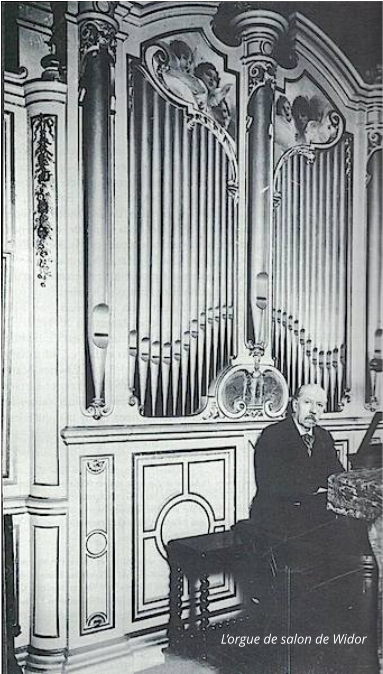
Charles-Marie Widor
In 1892, Charles-Marie Widor commissioned Cavaillé-Coll
fils to create a 10-stop salon organ whose case was
inspired by the 1747 organ known as the "du Dauphin"
organ, kept at the Palace of Versailles. After moving several
times over the years, the organ was finally installed in 1986
at Selongey (Bourgogne).
•
Owner unknown (1)
Now at the chapelle de Franklin du Collège et lycée Saint-
Louis-de-Gonzague. The date and provenance of the organ
are unknown, but it is possible that it was an old chamber
organ (perhaps built by Aeolian Skinner). It was purchased
by the college in 1964.
•
Unknown owner (2)
Unit Baby, Dargassies-Gonzalez, 1990, II/19.
This organ has had three successive owners since its
construction, and it has always been used as a study
instrument in private housing. The last owner housed in
the 14th arrondissement of Paris. Currently in the parish
church of St. John the Baptist, located in the village of San
Giovanni d'Asso, hamlet of Montalcino, Tuscany.








Organs of Paris


Chamber organs
(Residence organs/Home organs/House organs -
Orgues de salon)
Non-exhaustive list

ORGANS OF PARIS © 2026 Vincent Hildebrandt

•
Comtesse de Béhague
Organ Charles Mutin (1906), moved to the Palais de
Béhague in the big concert hall (Salle Byzantin).
•
Comte Béranger de Miramon Fitz-James
Co-founder of Les Amis de l’Orgue together with
Norbert Dufourcq. In 1926, he had a salon organ
built by organ builder Victor Gonzalez. It was
inaugurated on June 27, 1926, by André Marchal.
•
Philippe Bellenot (1860-1928)
Organ of Mutin (1914). Composition.
•
Olivier Bernard (rue Prony)
Organ built by P. Hartmann
•
Mme Roux de Bezieux (avenue du Président
Wilson)
Organ of Schwenkedel, 1965.
•
Comte Christian de Bertier de Sauvigny
Organ Merklin (1904). It’s a chamber organ (III/30) of
the landgrave Christian Bertier de Sauvigny (1864-
1939). It was moved to Saint-Dominique in 1944-45.
Plus d’info…
•
Joseph Bonnet
Organ Mutin (1912, transformed by Convers in
1924). Now in the chapelle Sainte-Jeanne-d'Arc de
Coetquidan (Morbihan). Thanks to Olivier Geoffroy
for this information. Composition.
•
Nadia Boulanger (1887-1979)
Organ Mutin inaugurated on February 4, 1905. After
her death, the organ is given to the musée de la Cité
de la musique in Paris. Composition.
Another house organ of her is now at the Saint-
Jacques Convent.
•
André Chauvin
Organ Benoit et Sarelot (1986), designed by André
Isoir. Originally, it was the personal organ of André
Chauvin, organist of the Prytanée militaire de La
Flèche. The organ was sold in 2014 to the Centre
Hospitalier National d’Ophtalmologie des Quinze-Vingts
and installed in the Chapelle Saint-Remi.
•
Pierre Cochereau ( bd Berthier)
•
Comtesse de Cossé-Brissac
Organ Mutin (1905). Now in Notre-Dame de
Sancerre (Cher). Composition.
•
Jeanne Demessieux
Organ of Roethinger. This instrument was installed
at the house of Michel Faverais à la Ferté-sous-
Jouarre.
•
Pierre Denis (rue Boileau)
Organ of Gonzalez.
•
Sarah Louis-Dreyfus
Orgue Charles Mutin (124, III/29)
Thanks to Jim Lewis for the photo of the organ.
This organ was transfered in 1953 to the Chapelle de
l’école Saint-Charles d’Athis-Mons. Source
•
Mme Dujarric
In 1988, this organ of the mansion of Ms Dujarric in
Boulogne-Billancourt, was given to the parish of
Sainte-Odile: due to financial restrictions, the
pipework is not yet installed.
•
Norbert Dufourcq
•
Marcel Dupré
An important part of the organ of Saint-Gabriel (built
by Chrétien et Laurent Steinmetz in 1982) comes
from a Cavaillé-Coll chamber organ which is said to
belonged to Marcel Dupré.
•
Maurice and Marie-Madeleine Duruflé
Organ Gonzalez, 1967 (III/30)
•
Baron d'Erlanger
Organ Cavaillé-Coll, 1865 (opus 250-229). It was
given to the city oif Paris in 1927 by the son of the
baron, and then installed in the chapel of the
Sorbonne by Convers-Cavaillé-Coll and then installed
at Saint-Jacques-du-Haut-Pas.
•
Salon de Mme Flersheim (Rue du Ranelagh)
Inauguration of an organ Cavaillé-Coll-Victor
Gonzalez by André Marchal, June 27, 1931.
•
Jean Galard
Organ (Baby-)Gonzalez, 196x (II/2)
•
Eugène Gigout
A small organ Cavaillé-Coll (1987) in the mansion of
Gigout at 63 bis rue Jouffroy (XVIIe Arr ). The organ
was equipped with a manual blower that his
students operated themselves during lessons.
Gigout sold his organ in 1900 to the Ecole des
Francs-Bourgeois.
•
Salle de Musique of the Henry Goüin
Henry Goüin (Henry Jules Goüin, 1900–1977), a
passionate music lover, had his townhouse on
Avenue Milleret-de-Brou enlarged in 1932 to include
a music room. He had a Gonzalez organ installed
there, which was inaugurated by organist André
Marchal. The music room soon became one of the
most sought-after in Paris, and the organ was also
used for recordings. Two years before his death, the
organ was moved to Sainte-Marguerite Church in Le
Vésinet. In 2002, it was restored by Marc Hédelin:
the console was replaced, an electronic combination
system was added, and six new stops were
introduced.
•
Charles Gounod
Organ Cavaillé-Coll, 1879, II/16 (12). This organ
remained until 1937 in the master's salon (located at
20 Place Malesherbes in Paris) until his daughter,
the Baroness de Lassus, gave it to the Institut des
Jeunes Aveugles in Bordeaux at the instigation of
André Marchal. It was transferred from Bordeaux to
Ambarès-la-Grave (Gironde) to the Institute for the
Deaf and Blind (IRSA) in his original state. It has been
classified as a historical monument since 2009. It is
now installed and restored in the church of La Sauve
Majeure (Gironde).
•
Jean Huré
Organ Cavaillé-Mutin (1915-1920). Now in Saint
Christophe de Javel. In 1970, it was reconstructed by
Schwenkedel.
•
Georges Jacob (1877-1950)
Organ Mutin (1900-1905). Now in Sainte-Marie-
Madeleine de Domont. Composition.
•
Henri de Jouvenel (1876-1935).
His Parisian salon organ was installed by E. F.
Walcker in 1930. Composition. Many thanks to James
Lewis for this information.
•
Jean Langlais
Organ of 2 manuals.
•
André Marchal
Rue Duroc
•
Léonce de St Martin
Organ Gaston Gutschenritter (1922), moved to Notre
Dame de l’Assomption de Passy in 1959.
Composition
•
Baron Albert de l'Espée
See: Sacré-Coeur and Saint-Antoine-de-quinze-vingts
•
André Marchal
The organ at rue Duroc had originally two manuals and
pedal, built by Gütschenritter. It was gradually enlarged.
After the end of World War II, Victor Gonzalez took over
and a third manual, an unenclosed Positif, was added.
More information…
•
Baron Albert de l'Espée
See: Sacre-Coeur et Saint-Antoine-de-quinze-vingts
•
Comtesse Anna de Noailles
Organ Cavaillé-Coll (1898).
The Countess sold it in 1905 to the Aviné family of
Dreux (Eure-et-Loir) to reward the grandson of the
family: Émile (pupil of Alexandre Guilmant and Louis
Vierne) with his first organ prize (1904). He ceded
the instrument to the parish of Saint-Joseph des
Épinettes at the end of 1910. According to the
national inventory of organs, this organ is an old
salon organ built by Cavaillé-Coll in 1880 for Samuel
Rousseau, as a gift following the obtaining of his
Organ Prize at the Paris Conservatory in the class of
Alexandre Guilmant.
•
Dr. Jean Perrot
Dr. Jean Perrot (1915-2009), a medical doctor in
Paris, devoted most of his free time to the organ. In
1948, he had a salon organ built by Victor Gonzalez,
following the expert advice of André Marchal. Many
private concerts were held around his instrument,
bringing together some of the greatest organists of
the time, including Gaston Litaize — who dedicated
one of his preludes to him — Norbert Dufourcq,
Marie-Claire Alain, Georges Robert, Claude
Dessenne, Jean Galard, and above all, André
Marchal.
•
Noëlie Pierront (19 rue Mazarine)
She was professor and organist at Saint Pierre du
Gros Caillou.
•
Léonce de Saint-Martin (Place des Vosges)
Organ of Gaston Gutschenritter (1922), transferred
to Notre Dame de l’Assomption de Passy in 1959.
Composition
•
Winnaretta Singer, princesse Edmond de
Polignac
Organ of Mutin-Cavaillé-Coll (1902, III/28, transfered  in 1935 to the Grand Séminaire of Lille.
Winnaretta Singer (1865-1943) was the daughter of
in 1935 to the Grand Séminaire of Lille.
Winnaretta Singer (1865-1943) was the daughter of
in 1935 to the Grand Séminaire of Lille.
Winnaretta Singer (1865-1943) was the daughter of


