



ORGANS OF PARIS © 2026 Vincent Hildebrandt HOME ALL ORGANS
Other organ builders of the 19th century


Louis Béasse et Jean-Baptiste Bonneau
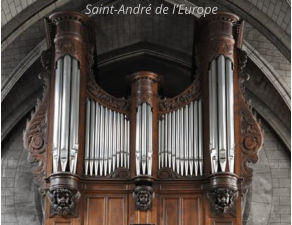
Louis Béasse trained in pipe organ building with Aristide Cavaillé- Coll, probably from the 1870s (his father Modeste also worked at Cavaillé-Coll from 1853 to 1892). Having become the "First worker" at the Cavaillé-Coll manufactory, specializing in mechanics, he decided to start his own workshop with Jean-Baptiste Bonneau, also a "First worker" at the same firm, specializing in harmonization, early in 1892, with the help of his father who was a specialist in building wind chests at Cavaillé and his brother who was a harmonizer at Cavaillé. Around 1903, the two former "First workers" parted. Ernest Béasse took over the workshop alone with his son Louis. Louis continued to work in this trade after his father's death on March 11, 1908 in Paris 15th. Saint-Louis-des-Invalides - Saint-André de l’Europe .L’abbé Clergeau
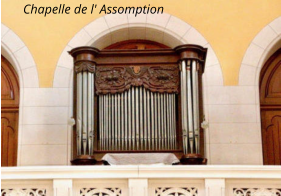
L’abbé Clergeau, very gifted in business, had developed a manufacture of small series organs intended to accompany an assembly for a fairly reduced price. The little organ of the Chapelle de l' Assomption can probalby be attribuated to him. More information on Clergeau (in French).Delmotte
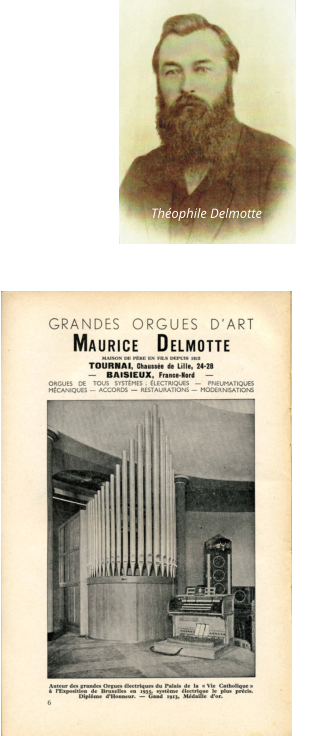
The Maison Delmotte: a long family tradition of organ builders passed from father to son. In 1812, Pierre-Fidèle Delmotte (1792-1867), watchmaker as his father, and then organist, created his own firm at Saint-Léger Hainaut, Belgium. He joined for a decade with his brother. His son Théophile (1833- 1909) went to work with his older brother Constantin in the Studio in Saint- Léger, from 1855 until 1871. Théophile went to Paris in 1855 to learn at the Cavaillé-Coll workshop. He started a new workshop in Tournai, Belgium, in 1872, along with another brother, Edouard. Upon the death of the latter in 1899, Théophile directed the company on his own and in 1903, he took his son Maurice in the company. When Théophile died in 1909, Maurice was the only manager until he was succeeded by his own 21-year-old son Georges in 1946. Maurice Delmotte (1885-1961) showed an intense activity in the field of the electric traction and built the monumental organ (110 stops) at the National Institute of broadcasting (I.N.R.) in Ixelles (Brussels) in 1940. After the unexpected death of Georges, the family tradition was continued by two of his nephews, Guy Seghers and Denys Delporte. The son of George, Etienne Delmotte, became the general manager of the company. They now build organs using all transmission systems (mechanical, electrical, pneumatic or electronic). The work list of the Delmottes company mentions the construction of approximately 150 new organs and 100 major works and restorations. More information on Delmotte here (in French). There is one organ of Delmotte in Paris, at Saint-André-de-l’Europe.Henry Didier
Henry Didier (1861-1918) learned his skills in the workshop of his father Charles Didier (1831-1881), who had been apprentice at the workshop of Merklin. After a period in the Caribbean region, he returned to France in 1889 and in 1890 he was associated with Mutin (Mutin et Cie) for a short period. After a successful period during the years 1890-1900, his workshop steadily lost quality and work. His son François Didier (1894-1939) tried to recover the firm, but eventually, he had to sell his workshop in 1930 to Jacquot (Rambervillers). He built the organ of Saint-Joseph-des-carmes (1902)Joseph Arnoud Fermis
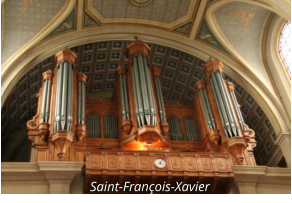
Joseph Arnaud Fermis (1836-1889) was the son of François Sylvain Fermis, a carpenter who built organ cases for the Parisian firm of Barker and Verschneider (1860s). This company hired Joseph Arnaud, being already trained as a carpenter, organbuilder and organist. Joseph Fermis was the first one to apply a tubular action system to slider soundboards and slider chests, patented in 1866. This system was applied in 1878 for the new organ of Saint- François-Xavier in Paris, but removed in 1923. The only authentic organ of Fermis with this system existing today is the organ of Foix, St. Volusien. He also built organs for the St. Denis Cathedral in Réunion and for the Beijing Cathedral. SourceJean-Baptiste Gadault
Jean-Baptiste Gadault (??-1845) and his son Charles (1828-1883) were organ builders active in Paris in the middle of the XIXth century. Charles Gadault worked on the organ of St. Louis des Invalides in 1853.Hubert-François Krischner
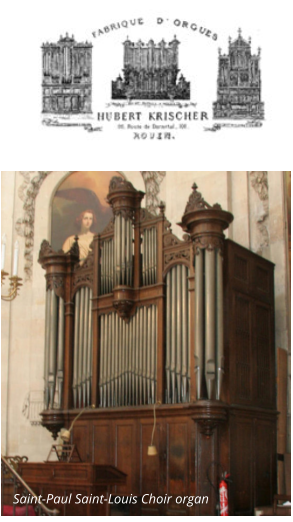
The son of a family originally from Nideggen near Aachen, Jean-Hubert Krischer (1812 – 1890) was a Parisian organ builder and father of two organ builders: Marie-Joseph (1843 – 1876), and Hubert François (1834 – 1893). Jean-Hubert became foreman at Daublaine-Callinet with the team of Stoltz, Poirier, Lieberknecht, Sauvage and Maillard around 18411. Subsequently, he worked at Cavaillé-Coll and Merklin, which he then left to join the team of the Parisian builder Narcisse Martin as a workshop manager Hubert François Krischer (1834-1893) trained with the organbuilders Cavaillé- Coll, Daublaine, Merklin and Martin. He founded his own company in 1877 in Rouen. He can be considered the successor of Narcisse Martin. His father Jean (1797-?) worked with Daublaine. Hubert had four sons (Georges, Henri, Ernest and Paul) who learned their trade in their father's workshop. This dynasty began in 1753 and ended with Paul's death in 1934. He restored the choir organ of Saint-Paul-Saint-Louis (1885).Orgelbau Link
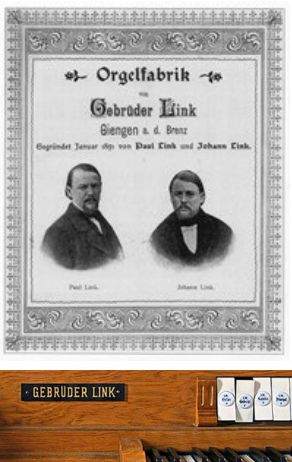
This German firm was founded in 1851 by the twin brothers Link: Paul (1821- 1891) and Johannes (1821-1872). Thanks to the excellent reputation of the organs built by the Link brothers, the factory continues to expand, applying the principles of industrial organ building. Johann Link died in 1871 and his son Paul continued to run the company on his own. In 1886 the business was taken over by Paul Link's eldest son, Eugen (1855- 1940) and continued successfully. Even in France, despite the war of 1870- 1871, this German firm, known for its exemplary work, was called upon. Based in Giengen an der Brenz, the company still exists and has built more than a thousand instruments worldwide. The only organ in Paris of this firm is located at the l 'église luthérienne de l'ascension (Paris XVII), built in 1894 and still in its original state. Its construction is probably due to the Alsatian émigré parishioners whose presence of this factor was very present in Alsace, among the Lutherans. It is a fine example of German industrial organ building.Hippolyte Loret
Hippolyte Loret ( 1810–1879) became one of the most important representatives of the symphonic organ type in Belgium. The Loret family is a Flemish family of organ builders, originating from Dendermonde. Jean-Joseph Loret (1757–1847) is the founder. His son François-Bernard Loret, together with his younger brother Hippolyte, brought the peak of the Loret family's organ-building art. Both already learned the craft at a young age in their father's workshop in Dendermonde. Hippolyte first settled in Termonde and still resided there in 1854 when the first of the Van Bever brothers, Adrien, joined his c ompany as a carpenter. He settled in Brussels in 1840. Following family complications, he left Belgium in 1876 and settled in Paris, 67 Boulevard Saint-Jacques, where he died in 1879. Hippolyte built around 450 organs, including the organ in the abbey of Averbode, completed in 1859, a masterpiece of the Belgian organ building of that time. Many other organ builders received their training with him, including the Van Bever Brothers, who took over his workshop in 1880. Saint-Joseph-artisan - Saint-IgnaceNarcisse Martin
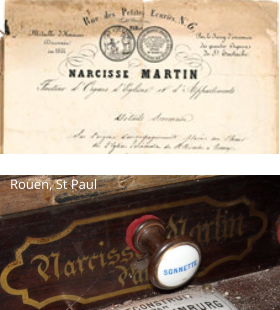
Little is known about Narcisse Martin. He learned his skills at the Daublaine- Callinet-Ducrfoquet firm and started his won company in 1858. Hubert Krischer (1834-1895) was head of the workshop during the years 1858-1873. Martin built the organ of St-Paul-St-Louis (1871), which was modified during the years, but restored by Bernard Dargassies in the spirit of Martin in 2005.Pierre Ménard
In Coutances, from 1839 to 1892, six organ builders from the Ménard- Orange-Laforge family built, restored, and maintained organs in the Manche region of France and even beyond. Pierre Ménard, born in Courcy in 1799, trained as an organ builder and first worked in Paris as a journeyman. He worked in Paris for Louis Callinet and Aristide Cavaillé-Coll. In 1839, he returned to Coutances to set up his workshop. Célestin Ménard, Pierre's half- brother and 21 years younger, worked and learned the trade with Pierre from the company's founding. But in 1845, he set up on his own to make pianos, harmoniums, and small organs. He presented an instrument at the Universal Exhibition in Paris in 1855. Ménard was very active in Normandy. He built instruments with his cousin Eugène Orange and a partner Henri Laforge in Lower Normandy, and also constructed small organs as a subcontractor for Cavaillé-Coll. Lutheran Church La Trinité.Van Bever
The brothers Adrien (1837–1895) and Pierre-Salomon (1851–1916) Van Bever were well-known Flemish organ builders and important Belgian representatives of the French Romantic organ-building style. Adrien was a former student of Hippolyte Loret, whose workshops he took over before settling with his brother in Laeken (Brussels) in 1880. The company then took the name Van Bever Frères, ancienne maison H. Loret. Adrien Van Bever returned from Paris to Laeken. They also had a branch in Amiens (northern France) for many years, which closed in 1904. After the deaths of Adrien (1895) and Salomon (1916), François, Louis, and Nicholas Draps, nephews of Salomon, took over the company and continued it as Van Bever Frères in Laeken until 1925. Saint-Joseph-Artisan










Organs of Paris


Other organ builders
of the 19th century

ORGANS OF PARIS © 2026 Vincent Hildebrandt




Louis Béasse et Jean-Baptiste Bonneau
Louis Béasse trained in pipe organ building with Aristide Cavaillé- Coll, probably from the 1870s (his father Modeste also worked at Cavaillé-Coll from 1853 to 1892). Having become the "First worker" at the Cavaillé-Coll manufactory, specializing in mechanics, he decided to start his own workshop with Jean-Baptiste Bonneau, also a "First worker" at the same firm, specializing in harmonization, early in 1892, with the help of his father who was a specialist in building wind chests at Cavaillé and his brother who was a harmonizer at Cavaillé. Around 1903, the two former "First workers" parted. Ernest Béasse took over the workshop alone with his son Louis. Louis continued to work in this trade after his father's death on March 11, 1908 in Paris 15th. Saint-Louis- des-Invalides - Saint-André de l’Europe .L’abbé Clergeau
L’abbé Clergeau, very gifted in business, had developed a manufacture of small series organs intended to accompany an assembly for a fairly reduced price. The little organ of the Chapelle de l' Assomption can probalby be attribuated to him. More information on Clergeau (in French).Delmotte
The Maison Delmotte: a long family tradition of organ builders passed from father to son. In 1812, Pierre-Fidèle Delmotte (1792-1867), watchmaker as his father, and then organist, created his own firm at Saint-Léger Hainaut, Belgium. He joined for a decade with his brother. His son Théophile (1833-1909) went to work with his older brother Constantin in the Studio in Saint-Léger, from 1855 until 1871. Théophile went to Paris in 1855 to learn at the Cavaillé-Coll workshop. He started a new workshop in Tournai, Belgium, in 1872, along with another brother, Edouard. Upon the death of the latter in 1899, Théophile directed the company on his own and in 1903, he took his son Maurice in the company. When Théophile died in 1909, Maurice was the only manager until he was succeeded by his own 21-year-old son Georges in 1946. Maurice Delmotte (1885-1961) showed an intense activity in the field of the electric traction and built the monumental organ (110 stops) at the National Institute of broadcasting (I.N.R.) in Ixelles (Brussels) in 1940. After the unexpected death of Georges, the family tradition was continued by two of his nephews, Guy Seghers and Denys Delporte. The son of George, Etienne Delmotte, became the general manager of the company. They now build organs using all transmission systems (mechanical, electrical, pneumatic or electronic). The work list of the Delmottes company mentions the construction of approximately 150 new organs and 100 major works and restorations. More information on Delmotte here (in French). There is one organ of Delmotte in Paris, at Saint-André-de-l’Europe.Henry Didier
Henry Didier (1861-1918) learned his skills in the workshop of his father Charles Didier (1831-1881), who had been apprentice at the workshop of Merklin. After a period in the Caribbean region, he returned to France in 1889 and in 1890 he was associated with Mutin (Mutin et Cie) for a short period. After a successful period during the years 1890-1900, his workshop steadily lost quality and work. His son François Didier (1894-1939) tried to recover the firm, but eventually, he had to sell his workshop in 1930 to Jacquot (Rambervillers). He built the organ of Saint-Joseph-des-carmes (1902)Joseph Arnoud Fermis
Joseph Arnaud Fermis (1836-1889) was the son of François Sylvain Fermis, a carpenter who built organ cases for the Parisian firm of Barker and Verschneider (1860s). This company hired Joseph Arnaud, being already trained as a carpenter, organbuilder and organist. Joseph Fermis was the first one to apply a tubular action system to slider soundboards and slider chests, patented in 1866. This system was applied in 1878 for the new organ of Saint-François- Xavier in Paris, but removed in 1923. The only authentic organ of Fermis with this system existing today is the organ of Foix, St. Volusien. He also built organs for the St. Denis Cathedral in Réunion and for the Beijing Cathedral. SourceJean-Baptiste Gadault
Jean-Baptiste Gadault (??-1845) and his son Charles (1828- 1883) were organ builders active in Paris in the middle of the XIXth century. Charles Gadault worked on the organ of St. Louis des Invalides in 1853.Hubert-François Krischner
The son of a family originally from Nideggen near Aachen, Jean-Hubert Krischer (1812 – 1890) was a Parisian organ builder and father of two organ builders: Marie-Joseph (1843 – 1876), and Hubert François (1834 – 1893). Jean-Hubert became foreman at Daublaine-Callinet with the team of Stoltz, Poirier, Lieberknecht, Sauvage and Maillard around 18411. Subsequently, he worked at Cavaillé-Coll and Merklin, which he then left to join the team of the Parisian builder Narcisse Martin as a workshop manager Hubert François Krischer (1834-1893) trained with the organbuilders Cavaillé-Coll, Daublaine, Merklin and Martin. He founded his own company in 1877 in Rouen. He can be considered the successor of Narcisse Martin. His father Jean (1797-?) worked with Daublaine. Hubert had four sons (Georges, Henri, Ernest and Paul) who learned their trade in their father's workshop. This dynasty began in 1753 and ended with Paul's death in 1934. He restored the choir organ of Saint-Paul-Saint-Louis (1885).Orgelbau Link
This German firm was founded in 1851 by the twin brothers Link: Paul (1821-1891) and Johannes (1821-1872). Thanks to the excellent reputation of the organs built by the Link brothers, the factory continues to expand, applying the principles of industrial organ building. Johann Link died in 1871 and his son Paul continued to run the company on his own. In 1886 the business was taken over by Paul Link's eldest son, Eugen (1855-1940) and continued successfully. Even in France, despite the war of 1870-1871, this German firm, known for its exemplary work, was called upon. Based in Giengen an der Brenz, the company still exists and has built more than a thousand instruments worldwide. The only organ in Paris of this firm is located at the l 'église luthérienne de l'ascension (Paris XVII), built in 1894 and still in its original state. Its construction is probably due to the Alsatian émigré parishioners whose presence of this factor was very present in Alsace, among the Lutherans. It is a fine example of German industrial organ building.Hippolyte Loret
Hippolyte Loret ( 1810–1879) became one of the most important representatives of the symphonic organ type in Belgium. The Loret family is a Flemish family of organ builders, originating from Dendermonde. Jean-Joseph Loret (1757–1847) is the founder. His son François-Bernard Loret, together with his younger brother Hippolyte, brought the peak of the Loret family's organ-building art. Both already learned the craft at a young age in their father's workshop in Dendermonde. Hippolyte first settled in Termonde and still resided there in 1854 when the first of the Van Bever brothers, Adrien, joined his c ompany as a carpenter. He settled in Brussels in 1840. Following family complications, he left Belgium in 1876 and settled in Paris, 67 Boulevard Saint- Jacques, where he died in 1879. Hippolyte built around 450 organs, including the organ in the abbey of Averbode, completed in 1859, a masterpiece of the Belgian organ building of that time. Many other organ builders received their training with him, including the Van Bever Brothers, who took over his workshop in 1880. Saint-Joseph-artisan - Saint-IgnaceNarcisse Martin
Little is known about Narcisse Martin. He learned his skills at the Daublaine-Callinet-Ducrfoquet firm and started his won company in 1858. Hubert Krischer (1834-1895) was head of the workshop during the years 1858-1873. Martin built the organ of St-Paul-St-Louis (1871), which was modified during the years, but restored by Bernard Dargassies in the spirit of Martin in 2005.Pierre Ménard
In Coutances, from 1839 to 1892, six organ builders from the Ménard-Orange-Laforge family built, restored, and maintained organs in the Manche region of France and even beyond. Pierre Ménard, born in Courcy in 1799, trained as an organ builder and first worked in Paris as a journeyman. He worked in Paris for Louis Callinet and Aristide Cavaillé-Coll. In 1839, he returned to Coutances to set up his workshop. Célestin Ménard, Pierre's half-brother and 21 years younger, worked and learned the trade with Pierre from the company's founding. But in 1845, he set up on his own to make pianos, harmoniums, and small organs. He presented an instrument at the Universal Exhibition in Paris in 1855. Ménard was very active in Normandy. He built instruments with his cousin Eugène Orange and a partner Henri Laforge in Lower Normandy, and also constructed small organs as a subcontractor for Cavaillé-Coll. Lutheran Church La Trinité.Van Bever
The brothers Adrien (1837–1895) and Pierre-Salomon (1851–1916) Van Bever were well-known Flemish organ builders and important Belgian representatives of the French Romantic organ-building style. Adrien was a former student of Hippolyte Loret, whose workshops he took over before settling with his brother in Laeken (Brussels) in 1880. The company then took the name Van Bever Frères, ancienne maison H. Loret. Adrien Van Bever returned from Paris to Laeken. They also had a branch in Amiens (northern France) for many years, which closed in 1904. After the deaths of Adrien (1895) and Salomon (1916), François, Louis, and Nicholas Draps, nephews of Salomon, took over the company and continued it as Van Bever Frères in Laeken until 1925. Saint-Joseph-Artisan
