



ORGANS OF PARIS © 2026 Vincent Hildebrandt HOME ALL ORGANS


The organ builders
of the 21th century
Aubertin Blumenröder Cattiaux-Chevron Cogez Coutelier - Dargassies Fossaert Gaupillat Grenzing Jurine Lacorre Muhleisen Plet Quoirin Rieger
Organ building in the 21st century:
a fruitful development!
In the last decades of the twentieth century, nineteenth- century organ building was rediscovered, which for some time was widely disparaged. At the dawn of the 21st century, the 19th century symphonic organ was thus brought back into the spotlight, giving rise to a more scrupulous restoration policy, thus respecting the Venice Charter (1964). In recent years, the work carried out on Parisian organs can be summarized in four main groups: • Restorations aimed at returning to the original state or a previous state (more or less close to the original instrument). These restorations are part of the heritage conservation policy and in compliance with the Venice Charter. Let us mention here the exemplary restorations of the organs of Bécon les Bruyères (2015). • Restorations with modifications and/or enlargements. The nature of this work makes it possible to embellish existing instruments and sometimes to correct their defects while respecting the present workmanship and the legacy of the past. We can mention the work carried out on the organs of Notre-Dame D'Auteuil (2018), of Notre Dame de Paris (2014) and the Basilica Ste Clotilde (2005). • The creation of new organs. Although rare at the beginning of the twenty-first century, the capital has been able to equip itself with new instruments often financed by private funds, among which we can mention the Aubertin organ at the church of St Louis- en-l'ile (2004), the Rieger organ at the Philharmonie (2016), the Grenzing organ at the auditorium of Radio France (2016) and the Chevron organ of the Chapel Notre-Dame du Saint Sacrement (2017). • Maintenance and restorations. The latter are the most common due to pollution and the often intensive use of the capital's organs. However, the maintenance and restoration of the existing Parisian organs is severely hampered due to a lack of funds; most restorations in this era were privately funded (e.g. Sainte Clotilde, 2006). Numerous organ concerts and auditions testify to the enthusiasm of listeners for organ music. Since 2009, a Paris Organ Festival has been held every year. On the occasion of a new series of organ concerts, this festival intends to embody a simple idea: the organ is a resolutely modern instrument! Many parishes offer organ concerts throughout the year, sometimes weekly or monthly (Ste-CLotilde, St-Eustache, Notre-Dame, St-Sulpice) which allow to retain a music- loving and passionate audience. Parallel to the cultural activity of the organ, the organ continues to serve the liturgy. If in many Parisian parishes the liturgy has deteriorated considerably with the arrival of the Second Vatican Council, a number of large parishes such as the Basilica Ste-Clotilde, St-Severin, La Madeleine try to remain faithful to beautiful music and dignified liturgy. A number of parishes celebrating in the form of the extraordinary rite rightly preserve the Gregorian chant (Ste-Cecilia, St-Roch, St-Nicolas du Chardonnet).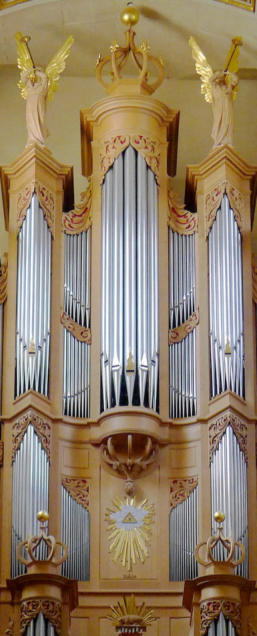
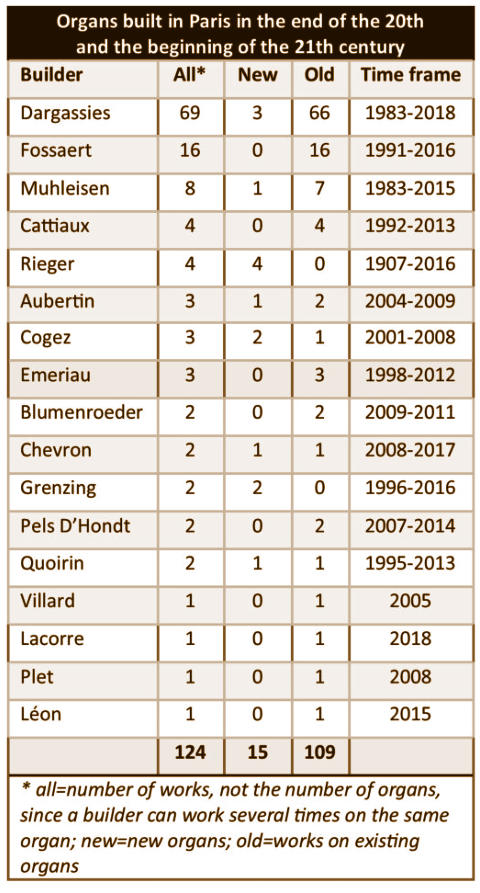


The
table
shows
the
main
organ
builders
of
the
21th
century
(and
last
decades
of
the
20th
century)
and
the
numbers
of
organs
they
built
or
restored and/or renovated.
This
table
shows
the
dominance
of
Dargassies,
in
particular
in
the
last
decades of the 20th century.
In
this
era,
there
are
15
new
organs
to
welcome,
a
sharp
decline
in
relation
to
the
numbers
presented
before
on
the
19th
and
20th
century,
but
still
impressive
when
realising
that
this
‘market’
is
well
saturated
after
centuries of organ building activities in Paris.








Organs of Paris


ORGANS OF PARIS © 2026 Vincent Hildebrandt




Organ building in the 21st century:
a fruitful development!
In the last decades of the twentieth century, nineteenth- century organ building was rediscovered, which for some time was widely disparaged. At the dawn of the 21st century, the 19th century symphonic organ was thus brought back into the spotlight, giving rise to a more scrupulous restoration policy, thus respecting the Venice Charter (1964). In recent years, the work carried out on Parisian organs can be summarized in four main groups: • Restorations aimed at returning to the original state or a previous state (more or less close to the original instrument). These restorations are part of the heritage conservation policy and in compliance with the Venice Charter. Let us mention here the exemplary restorations of the organs of Bécon les Bruyères (2015). • Restorations with modifications and/or enlargements. The nature of this work makes it possible to embellish existing instruments and sometimes to correct their defects while respecting the present workmanship and the legacy of the past. We can mention the work carried out on the organs of Notre-Dame D'Auteuil (2018), of Notre Dame de Paris (2014) and the Basilica Ste Clotilde (2005). • The creation of new organs. Although rare at the beginning of the twenty-first century, the capital has been able to equip itself with new instruments often financed by private funds, among which we can mention the Aubertin organ at the church of St Louis-en-l'ile (2004), the Rieger organ at the Philharmonie (2016), the Grenzing organ at the auditorium of Radio France (2016) and the Chevron organ of the Chapel Notre-Dame du Saint Sacrement (2017). • Maintenance and restorations. The latter are the most common due to pollution and the often intensive use of the capital's organs. However, the maintenance and restoration of the existing Parisian organs is severely hampered due to a lack of funds; most restorations in this era were privately funded (e.g. Sainte Clotilde, 2006). Numerous organ concerts and auditions testify to the enthusiasm of listeners for organ music. Since 2009, a Paris Organ Festival has been held every year. On the occasion of a new series of organ concerts, this festival intends to embody a simple idea: the organ is a resolutely modern instrument! Many parishes offer organ concerts throughout the year, sometimes weekly or monthly (Ste-CLotilde, St-Eustache, Notre-Dame, St-Sulpice) which allow to retain a music-loving and passionate audience. Parallel to the cultural activity of the organ, the organ continues to serve the liturgy. If in many Parisian parishes the liturgy has deteriorated considerably with the arrival of the Second Vatican Council, a number of large parishes such as the Basilica Ste-Clotilde, St-Severin, La Madeleine try to remain faithful to beautiful music and dignified liturgy. A number of parishes celebrating in the form of the extraordinary rite rightly preserve the Gregorian chant (Ste- Cecilia, St-Roch, St-Nicolas du Chardonnet).
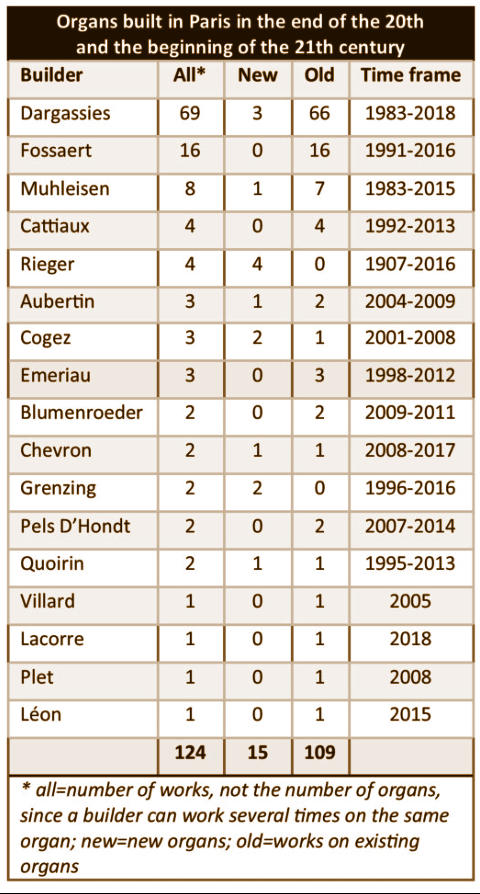
The
table
shows
the
main
organ
builders
of
the
21th
century
(and
last
decades
of
the
20th
century)
and
the
numbers
of
organs
they
built
or
restored
and/or
renovated.
This
table
shows
the
dominance
of
Dargassies,
in
particular in the last decades of the 20th century.
In
this
era,
there
are
15
new
organs
to
welcome,
a
sharp
decline
in
relation
to
the
numbers
presented
before
on
the
19th
and
20th
century,
but
still
impressive
when
realising
that
this
‘market’
is
well
saturated
after
centuries
of
organ
building activities in Paris.
Braillon - Brayé - Cailleux -
Deblieck - Dillenseger - Goussu -
Guyonnet - Klais - Léon -Mangeol
- Mascioni - Meier - Pellerin &
Uys - Requier - Robert Frères -
Toussaint - Venegoni
The organ builders
of the 21th century
Aubertin Blumenröder Cattiaux-Chevron Cogez Coutelier - Dargassies Fossaert Gaupillat Grenzing Jurine Lacorre Muhleisen Plet Quoirin Rieger
